How to Calculate a Contractor's Billable Labor Rate
Calculate a contractor labor selling rate from employment costs, realistic billable hours, allocated overhead, and a stated margin, with a worked example.
A service contractor pays a technician $32 an hour and charges the customer $50. The apparent $18 difference is not profit: it still has to cover employer taxes, insurance, benefits, unbilled paid time, and the technician's share of operating overhead.
Calculate the labor selling rate before entering it in a quote or estimate. In the worked example below, annual employment costs of $90,968.64, allocated overhead of $38,000, and 1,426 billable hours produce a cost of approximately $90.44 per billable hour. A modeled 20% margin after those included costs requires approximately $113.05 per hour.
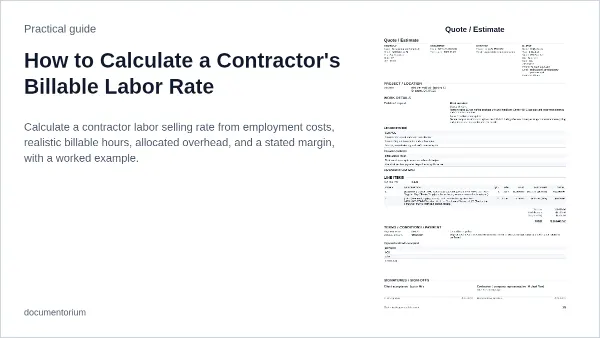
Those are hypothetical inputs, not recommended wages, market rates, or a guaranteed return. Keep the underlying worksheet in your spreadsheet or accounting system; the quote template documents the scope, quantities, and customer price you enter, not an automatic labor-rate calculation.
Define what one labor hour means
This example prices one technician-hour, not one truck-hour, crew-hour, or elapsed hour on site. Two technicians working for four hours use eight technician-hours. A crew rate needs a separate calculation that includes the crew's combined costs and realistic capacity.
Keep four different figures separate:
| Figure | What it measures |
|---|---|
| Hourly wage | The employee's pay rate before deductions |
| Loaded employment cost | Wages plus the employer costs assigned to that employee |
| Cost per billable hour | Employment cost and allocated overhead divided by hours expected to earn labor revenue |
| Labor selling rate | The customer-facing rate calculated from that cost and the chosen pricing target |
Use the same definition when preparing a construction quote. A paid-hour cost multiplied by billable hours will not recover all the paid time excluded from those hours.
1. Build the annual employment-cost total
Assume one employee receives $32 for each of 2,080 paid hours in the planning year. Paid holidays and leave are included within those hours. The model contains no overtime, bonuses, or additional taxable benefits; include their applicable costs if your actual staffing plan has them.
| Illustrative input | Annual amount |
|---|---|
| Gross wages: $32 × 2,080 paid hours | $66,560.00 |
| Employer Social Security and Medicare in this example | $5,091.84 |
| Budgeted federal and state unemployment | $2,329.60 |
| Budgeted workers' compensation | $7,987.20 |
| Employer benefit contributions | $7,200.00 |
| Other employee-related expenses assigned here | $1,800.00 |
| Total employment cost | $90,968.64 |
| Separately allocated operating overhead | $38,000.00 |
| Total annual cost to recover through this labor rate | $128,968.64 |
Replace the demonstration budgets with payroll reports, benefit invoices, insurer information, and applicable tax records. Do not use a national compensation average as your company's burden percentage. The BLS compensation definitions provide useful categories—paid leave, supplemental pay, insurance, retirement, and legally required benefits—but their statistical classifications are not a contractor pricing worksheet.
Check tax and insurance assumptions separately
For 2026, IRS Publication 15 gives an employer Social Security rate of 6.2% on covered wages up to the $184,500 wage base, plus an employer Medicare rate of 1.45% without that wage-base limit. The example's $66,560 of covered wages therefore produces $5,091.84 at the combined 7.65% rate. That calculation is not a universal percentage for every employee and every payment.
The unemployment line is a hypothetical combined budget, not a flat tax rate applied to all wages. Publication 15 explains the federal unemployment wage base and credit conditions; determine state unemployment separately using the applicable notice and rules. Employee tax withholding is already part of gross wages, not another employer expense to add on top.
Likewise, the workers' compensation amount is not a recommended trade rate. As a jurisdiction-specific example, the California Department of Insurance guide explains classification, payroll, rating adjustments, and premium audits. Use your jurisdiction's requirements and your own policy information rather than treating a California explanation as a nationwide rating rule.
Allocate overhead once
The $38,000 is this technician's assigned share of operating overhead, not necessarily the entire company's overhead budget. It might cover a defined share of dispatch, office expense, vehicles, software, and other operating costs not already included elsewhere.
Choose an allocation basis with your accountant and check that the allocations across all expected work recover the relevant budget. The construction-overhead allocation guide compares direct-cost and labor-hour bases and shows how a change in forecast workload affects the recovery rate. A phone, vehicle, tool allowance, or supervisor's time should not appear in both employee cost and overhead. If another fee or revenue stream already recovers a cost, account for that before assigning it again to labor.
2. Estimate realistic billable capacity
Do not divide annual cost by 2,080 merely because that is the paid-hours assumption. Some paid time will not generate separately billable labor revenue.
Use nonoverlapping categories drawn from your own records:
| Illustrative annual capacity calculation | Hours |
|---|---|
| Paid hours in the model | 2,080 |
| Less paid leave, excluding holidays below | −120 |
| Less paid holidays | −64 |
| Less training and meetings | −120 |
| Less other paid time not billed: travel, callbacks, gaps, and administration | −350 |
| Expected billable technician-hours | 1,426 |
This is approximately 68.56% of paid hours, not an industry utilization target. For fixed-price jobs, include the expected technician-hours needed to deliver the sold work even when the customer invoice has no hourly labor line. If travel or diagnostic fees recover some of the same costs, reconcile those fees with the labor-rate model rather than assigning the full cost to both.
Do not count leave twice. Because the $66,560 wage total already includes the modeled paid leave and holidays, their wage dollars are not added again. Reducing the billable-hours denominator accounts for their effect on available revenue-producing capacity.
Customer billability and employee pay are different questions. DOL Fact Sheet #22 explains compensable time under the FLSA, including travel between job sites during the workday and the conditions governing training time. An hour that cannot be charged to the customer is not automatically an unpaid hour. State rules may also apply.
Keep payroll and time records separately from customer paperwork. The jobsite time-tracking guide explains why payroll hours, job-cost hours, and customer billing quantities need reconciliation rather than being assumed identical.
3. Calculate cost, then apply the pricing target
First calculate the cost to recover through each billable hour:
Cost per billable hour = (annual employment cost + allocated overhead) ÷ expected billable hours
For the example:
- Annual cost to recover = $90,968.64 + $38,000 = $128,968.64.
- Cost per billable hour = $128,968.64 ÷ 1,426 = $90.4408415…, or approximately $90.44.
- Employment cost per paid hour alone = $90,968.64 ÷ 2,080 = approximately $43.73. This is a different measure and does not include the separate overhead allocation or reduced billable capacity.
For a modeled margin of 20% after the costs included here:
Labor selling rate = total annual cost ÷ expected billable hours ÷ (1 − target margin)
Enter the margin as a decimal: 20% is 0.20.
$128,968.64 ÷ 1,426 ÷ 0.80 = $113.0510519… per hour, or approximately $113.05.
Keep full precision until the final rounding step. If 20% is a strict minimum on these exact inputs, rounding up to $113.06 rather than down to $113.05 avoids falling slightly below it. A margin target must be below 100%, and expected billable hours must be greater than zero.
Adding a 20% markup to the cost instead gives approximately $108.53, which produces a margin of about 16.67%, not 20%. The markup vs. margin guide explains the different denominators.
This model includes an operating-overhead allocation before applying the margin. Its result is therefore not directly comparable to a gross-margin target calculated on direct job costs alone. The SEC's financial-statement guide distinguishes gross profit, operating profit, and later interest and income-tax deductions. The 20% here is a planning target after specified costs, not guaranteed after-tax net profit.
4. See what changes when billable hours fall
Holding annual employment cost and overhead constant shows how sensitive the result is to capacity:
| Expected billable hours | Share of 2,080 paid hours | Cost per billable hour | Rate for the modeled 20% margin |
|---|---|---|---|
| 1,664 | 80.00% | $77.51 | $96.88 |
| 1,426 | 68.56% | $90.44 | $113.05 |
| 1,040 | 50.00% | $124.01 | $155.01 |
Rates are rounded to cents. These are sensitivity calculations, not market-price recommendations or predictions that customers will accept the resulting rate. If more hours require overtime, additional vehicles, or other expenses, update the cost total as well; do not hold costs constant when the operating plan has actually changed.
A rate problem may also be a scheduling or workload problem. Before raising the target rate, investigate repeated return trips, unready jobs, unbilled gaps between appointments, and whether the expected annual workload is supported by records. Do not relabel warranty rework as chargeable labor simply to improve utilization.
5. Carry the rate into the right job documents
For one technician's four billable hours, the rounded example rate gives 4 × $113.05 = $452.20 in labor, before separately priced materials and any applicable tax. Two technicians working four hours each would use eight technician-hours, giving $904.40 at that same per-person rate. Label the unit so the customer can distinguish person-hours from elapsed time.
Keep the pricing calculation connected to the job without treating every internal assumption as an approved charge:
- Quote the actual scope. Enter the labor quantity, unit, chosen selling rate, and included work in the quote or estimate. For fixed-price work, the hourly model is an internal estimating input; it does not automatically convert the agreement to time and materials.
- Document the agreed billing basis. The written-quote guide helps record what the customer accepted. Identify any separate travel charge, minimum, diagnostic fee, or approval limit rather than adding it for the first time at billing.
- Authorize the visit. Use the work order for the agreed tasks and authorization limits. The internal worksheet does not authorize extra work or override an agreed rate.
- Record what actually happened. Use the service report for performed work, parts, findings, and follow-up. Reconcile it with separate payroll and time records; these documents are independent records, not an automatically synchronized cost system.
- Bill against the agreement. Enter supported quantities and agreed charges on the invoice. A new cost calculation does not by itself entitle the business to reprice an accepted job.
Do not add another blanket overhead percentage to this labor rate without checking the cost basis: the example already includes $38,000 of allocated overhead. Revisit the worksheet when wage rates, benefits, insurance, overhead, or billable capacity materially change, and compare estimated recovery with actual results using the same classifications.
Sources
Sources reviewed November 8, 2026:
- Internal Revenue Service: Publication 15 (2026), Employer's Tax Guide — Employer Social Security and Medicare rates, wage bases, and federal unemployment tax and credit conditions. Recheck the applicable year before reusing the tax inputs.
- Internal Revenue Service: Publication 334 (2025), Tax Guide for Small Business and Self-employment tax — Sole-proprietor pay and withdrawal treatment, and the distinction between employee payroll taxes and self-employment tax; not a pricing standard.
- U.S. Bureau of Labor Statistics: Employer Costs for Employee Compensation: Concepts — Compensation and benefit categories; not a company-specific labor burden or selling-rate recommendation.
- U.S. Department of Labor: Fact Sheet #22: Hours Worked Under the FLSA and Fact Sheet #23: Overtime Pay Requirements — Compensable time, travel between job sites, training-time conditions, and employee overtime pay; distinct from customer billability and selling rates.
- California Department of Insurance: Workers' Compensation Insurance — A California-specific explanation of classifications, payroll, premium adjustments, and audits; not nationwide pricing guidance.
- U.S. Securities and Exchange Commission: Beginners' Guide to Financial Statements — Gross profit, operating expenses, operating profit, and later interest and income-tax deductions.
Common questions
Is labor burden the same as a billable labor rate?
No. In this example, the costs above gross wages total $24,408.64, so the defined labor burden is $24,408.64 ÷ $66,560 ≈ 36.67% of wages. That percentage excludes the separately allocated $38,000 of overhead. A selling rate also accounts for billable capacity, overhead recovery, and the pricing target; adding 36.67% to the wage does not produce the customer rate.
Can I assume all 2,080 paid hours will be billable?
Not without evidence. The example subtracts paid leave, holidays, meetings, and other unbilled time to reach 1,426 hours. Use your own nonoverlapping categories and actual work mix rather than adopting that number as a target.
Should I charge the same hourly amount for a two-person crew?
Only if the agreed unit and rate are actually for the crew. A per-technician rate applies to each technician-hour: two people working four hours use eight technician-hours. Calculate and label a separate crew-hour rate if that is how you quote.
Does employee overtime mean I bill the customer time and a half?
Not automatically. DOL's overtime guidance generally requires covered nonexempt employees to receive at least one and one-half times their regular rate of pay for hours worked over 40 in a workweek. That is an employee-pay calculation, not a multiplier applied to the customer rate. Include expected overtime wages, related employer costs, and the resulting capacity in your worksheet. Any customer overtime or after-hours premium depends on the agreement and applicable rules; it does not arise merely because payroll overtime is due.
The after-hours service-pricing guide shows how to turn the cost calculation into disclosed dispatch charges, diagnostic limits, and separate repair approval.
Does a 20% margin mean multiplying cost by 1.20?
No. Multiplying by 1.20 applies a 20% markup and produces approximately 16.67% margin on the same cost basis. Divide cost by 0.80 for a 20% margin, and identify which costs the model includes.
Should I add another markup when using this rate in an estimate?
Not automatically. The example's $113.05 selling rate already includes allocated overhead and the modeled margin. If you build the job price from costs, use a cost-based labor input and apply the intended overhead and profit allowances consistently. If you use this selling rate as a priced labor line, do not treat it as raw labor cost and unknowingly add those allowances again.
How should I allow for warranty callbacks?
Include their expected costs and effect on billable capacity consistently. If their paid labor is already in annual wages, do not add those wage dollars again. Whether a visit can be charged to the customer depends on the warranty and agreement, not the internal recovery target.
Can a sole proprietor use this model to price their own time?
Use the cost-recovery approach, but do not copy the employee tax assumptions. Budget an allowance for your work and realistic revenue-producing hours. IRS Publication 334 explains that a sole proprietor is not an employee of the business and cannot deduct their own salary or personal withdrawals. Self-employment tax has a separate calculation. Have your accountant distinguish the pricing allowance from deductible expenses and owner withdrawals rather than copying the example's employer-only 7.65% calculation.
Does Documentorium calculate the rate from my payroll records?
No. Maintain the employment-cost, overhead, and capacity calculation separately. Use the quote template to document the resulting customer-facing quantities and prices; do not assume it imports payroll or calculates utilization.