After-Hours Emergency Service Pricing and Authorization
Price an after-hours service call with clear dispatch fees, diagnostic limits, repair approval, and a traceable final bill.
A furnace stops at midnight. The caller agrees to an emergency visit, but does that approval cover the dispatch fee, an hour of diagnosis, a replacement control, and a second technician? “Please come now” is not a useful description of the price or authorized work.
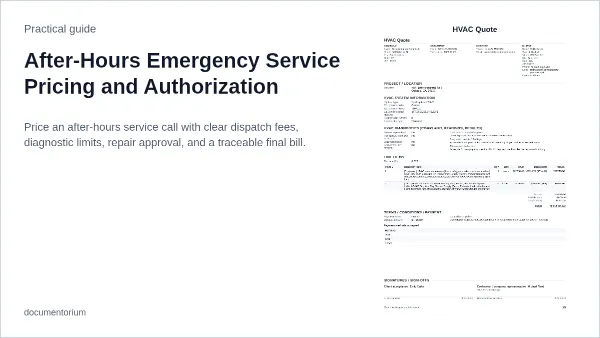
Price an after-hours call by defining the activation charge, labor basis, included diagnosis, likely extras, and spending limit before dispatch. For heating work, use the HVAC work order to record the agreed tasks and limits, supported by an itemized HVAC quote. Separate the initial assessment from the decision to buy a repair.
The workflow below uses a hypothetical furnace call. It is a pricing and documentation example, not a recommended rate schedule or a technical repair procedure.
Define the offer before dispatch
Record who requested service, their role and authority, the property and affected equipment, the reported condition, access arrangements, and the person available to approve more work. Preserve the caller's description rather than diagnosing the failure remotely.
Define when the after-hours rate applies: the time window, weekends and holidays, and whether a visit crossing into regular hours changes the labor rate. Tell the caller which schedule applies and whether it is based on the time of the request, arrival, or work performed. “After hours” should not leave the customer guessing which rate they accepted.
Make each charge understandable:
| Pricing component | What to state |
|---|---|
| Activation or dispatch fee | Amount, what it covers, when it is earned, when payment may be collected, and whether it is credited toward further work |
| Diagnostic labor | Per-technician or crew rate, included time, minimum if any, billing increments, and when chargeable time starts and stops |
| Travel and supplier access | Whether included, separately priced, or subject to further approval |
| Parts and materials | Included allowance or agreed pricing basis; distinguish diagnostic consumables from repair parts |
| Spending limit | What the ceiling includes, treatment of any applicable tax, and who may approve an increase |
| Repair decision | Whether any repair is already included or requires a separate scope and price |
If a flat diagnostic charge already includes the first hour, do not quietly add that hour again. If two technicians are needed, explain whether the rate is per person or for the crew. Identify any agreed cancellation or no-access charge before the customer accepts dispatch, not for the first time on the invoice.
For a related field workflow, the emergency plumbing authorization guide separates response, access, repair, and restoration. Those boundaries matter even when every step happens during one visit.
Build the rate from business costs, not a universal multiplier
Consider the actual cost of maintaining after-hours capacity: employee callout arrangements, employer costs, standby coverage, travel, dispatch support, supplier opening charges, and the personnel and equipment needed for the job. Obtain supplier charges directly rather than assuming a standard warehouse fee.
Use the billable labor-rate calculation as a starting point, then adjust the cost and capacity assumptions for the service you actually offer. Reconcile the overhead allocation with separate call fees so the same dispatch or vehicle cost is not counted twice in the internal recovery model. The markup and margin guide helps distinguish a cost increase from the selling-price calculation.
Keep that worksheet separately. The quote records the customer-facing scope and prices you enter; it does not import payroll, calculate standby costs, or establish that a premium is lawful.
Employee overtime is not the customer's rate
DOL's night-work guidance says the FLSA does not require extra pay merely for working at night. Its overtime guidance generally requires covered nonexempt employees to receive at least one and one-half their regular rate for hours worked over 40 in a workweek, not simply because the visit happens on a weekend.
DOL Fact Sheet #22 explains that compensable on-call and waiting time depend on the circumstances and restrictions. State rules and employment agreements may add requirements. Keep the required time and payroll records even when the customer's agreed billing basis does not charge for every paid hour.
Employee pay and the customer selling rate are separate calculations. Neither an automatic 1.5-times customer premium nor the absence of a premium follows from the FLSA alone.
Use staged approval where it fits
A useful control is to authorize the initial assessment, then obtain the required approval for further repair. This is a workflow choice, not a universal legally mandated two-stage system.
| Stage | Decision to record |
|---|---|
| Initial visit | Dispatch charge, diagnostic tasks, any specifically authorized temporary work, rates, and ceiling |
| Further repair | Findings, proposed work, parts, additional price, revised cumulative total or ceiling, and approver |
| Deferred or declined work | Condition left behind, restrictions and notifications, follow-up, and charges supported by the initial approval |
Use the work order's scope and notes for the agreed limits; retain the detailed approval record separately where needed. The HVAC diagnostic work-order guide helps distinguish a reported symptom, a confirmed finding, and proposed work. A change order can document an accepted expansion through the process required for the job.
Worked furnace-call example
Assume one technician and no applicable tax, separate travel fee, labor minimum, supplier-opening fee, or other charges in this simplified example. The customer authorizes diagnosis up to $395, including a $95 activation charge, labor at $180 per technician-hour billed in 15-minute increments, and agreed diagnostic materials. No permanent repair is included.
| Authorized initial work actually supplied | Amount |
|---|---|
| Activation charge | $95.00 |
| Diagnostic labor: 1.25 technician-hours × $180 | $225.00 |
| Diagnostic materials | $34.00 |
| Initial visit total | $354.00 |
The unused $41 of the $395 ceiling is not automatically billable. A not-to-exceed limit is not a fixed fee to collect regardless of the work supplied.
After diagnosis, the technician proposes a defined repair for an additional fixed $300, including its parts, labor, and stated verification. Before repair begins, the customer accepts that separate scope and price and the new $654 cumulative total. The supported combined charge is $354 + $300 = $654, not $395 + $300. Do not charge diagnostic time or materials a second time within an ambiguously described repair line.
A plain-language initial price note could read:
Initial authorization covers the $95 activation charge, diagnostic labor at $180 per technician-hour billed in 15-minute increments, and agreed diagnostic materials, up to $395 total. Permanent repair is not included. Contact the named approver before exceeding that total or starting additional work.
That note matches this example only. For an actual call, address applicable tax, other fees, scope, and required contract terms. It is not a cancellation waiver or a substitute for legally required notices. If the approver cannot be reached, do not treat silence as permission to exceed the authorization; follow the applicable safety and emergency requirements and document the unresolved decision.
Check pricing, cancellation, and payment rules
Disaster pricing
An individual equipment emergency is different from a legally declared disaster. A price accepted by the customer can still violate an applicable pricing prohibition.
California's Attorney General guidance on price gouging explains that Penal Code section 396 generally prohibits increases of more than 10% for covered goods and services after an emergency declaration, subject to specified exceptions. The applicable baseline and protection period matter, and state or local orders may extend protections. Texas's Attorney General guidance describes an excessive-or-exorbitant pricing standard rather than California's percentage framework. Do not copy one state's threshold into a nationwide emergency-rate policy.
Check the active declaration or order, location, service, applicable baseline, protection period, local rules, and permitted exceptions before offering disaster-period prices. Preserve the cost records supporting any claimed exception. This article does not determine whether a declaration covers a particular job.
Cancellation rights
Cancellation rights require a separate check. The FTC's Cooling-Off Rule overview explains coverage and exclusions; it is not a blanket statement that every urgent repair loses cancellation protection.
The federal rule's emergency exception, 16 CFR 429.0(a)(3), requires all of the following:
- The buyer initiated contact.
- The goods or services are needed to meet the buyer's bona fide immediate personal emergency.
- The buyer provides a separate, dated and signed statement in their own handwriting describing the emergency and expressly acknowledging and waiving the three-business-day cancellation right.
A preprinted blanket waiver or the price note above does not replace those conditions. A separate exclusion in section 429.0(a)(5) covers certain buyer-requested visits to repair or maintain personal property at the buyer's home; it does not cover every repair call or additional sale. State cancellation protections still require a separate check. Use a reviewed transaction-specific process; the contractor cooling-off guide provides related background.
Payment timing and California's service-and-repair category
State contract rules can also affect when you may collect payment. For example, California Business and Professions Code §7159.10 limits its special service-and-repair contract category to $750 or less, buyer-initiated contact, and work reasonably necessary for the reported problem, with no payment due or accepted before completion. Under that provision, completion means fully correcting the conditions that prompted the call and obtaining building-department acceptance where applicable. A diagnosis-only visit that leaves the problem unresolved does not qualify merely because it costs less than $750.
Qualifying contracts must be in writing, and the buyer must receive a copy signed and dated by both parties before work starts. For time-and-materials contracts under this section, exceeding the estimated contract amount requires the buyer's written authorization under section 7159.10(e)(7). A general instruction to obtain approval does not replace that requirement.
Section 7159.10(e)(11) also requires disclosure that only one service charge, including any trip charge or inspection fee, may be charged. Check the correct contract, notices, fee structure, and collection rules before dispatch rather than treating the example above as a California-compliant contract.
Close the visit against the actual approval
Record findings, work performed, relevant tests and their limits, unresolved conditions, and notifications in the HVAC service report. Describe temporary work honestly and identify what remains to be approved or completed. Spending authority does not authorize unsafe operation or work outside the contractor's qualifications.
On the invoice, separate the agreed initial charges from subsequently approved work. Reconcile actual quantities, any agreed credits, and the repair approval. Keep the quote, accepted version, work order, approval communications, report, and supplier evidence together.
Documentorium's PDFs support those records; generating a PDF does not itself obtain remote approval, deliver required notices, or synchronize separate documents. Arrange the required signature and delivery process separately.
Sources
Sources reviewed November 12, 2026:
- U.S. Department of Labor: Night Work and Shift Work, Overtime Pay, and Fact Sheet #22 — Federal employee-pay and hours-worked guidance, not a customer rate schedule.
- California Department of Justice: FAQs on Price Gouging — California-specific disaster pricing protections, periods, covered services, and exceptions; not nationwide pricing rules.
- California Legislature: Business and Professions Code §7159.10 — The special service-and-repair contract category, completion, payment and service-charge conditions, and required contract content; not a nationwide small-job exemption.
- Texas Attorney General: How to Spot and Report Price Gouging — Texas's disaster-related excessive or exorbitant pricing standard.
- Federal Trade Commission: Buyer's Remorse: The FTC's Cooling-Off Rule May Help and 16 CFR 429.0, 2026 edition — Federal coverage, exclusions, and the specific immediate-personal-emergency conditions; check state protections separately.
Common questions
Is time and a half the standard emergency customer rate?
No universal multiplier applies. Build the offer from your costs and agreed billing basis, then check applicable pricing limits. Employee overtime requirements are a separate question from what the customer may be charged.
Should I bill the full not-to-exceed amount if the visit costs less?
Not under the example's time-and-materials arrangement. The $395 ceiling limits the authorized charges; the supported initial bill is $354, leaving $41 unused. A separately agreed fixed fee is a different pricing basis. State the basis clearly and reconcile the invoice to it.
Can a supplier's emergency opening charge be passed through or marked up?
Check the agreed pricing basis and applicable limits. Obtain evidence of the actual charge and explain its treatment. Do not add an undisclosed fee merely because the supplier billed the shop.
What if the customer declines the repair after diagnosis?
Check the applicable contract and collection rules, then bill only charges supported by the initial authorization—not an unperformed repair or an unused ceiling. Follow applicable safety procedures and document findings, condition left behind, notifications, and the follow-up decision in the HVAC service report.
Does emergency approval authorize demolition or a replacement system?
Not automatically. Describe invasive access, restoration exclusions, and replacement work separately, and obtain the authorization and notices required for that scope. The word “emergency” does not settle the contract, cancellation, safety, or pricing rules.
Does an after-hours call automatically waive cancellation rights?
No. The time of the call and the customer's price approval do not establish a cancellation exception. Check federal coverage, the specific conditions of any claimed exception, and state protections. The cooling-off guide explains the separate notice and timing decisions.