Schedule of Values for Small Contractors: A Worked Example
Break a construction contract into billable work packages and follow a $168,000 renovation through two payment applications without double-counting stored materials.
A schedule of values (SOV) assigns part of the construction contract price to each work package so you can bill for progress. On a $168,000 shop renovation, “Construction: 50% complete” gives the reviewer little to check. Separate demolition, rough-in, finishes, and closeout so the reviewer can see what each amount pays for.
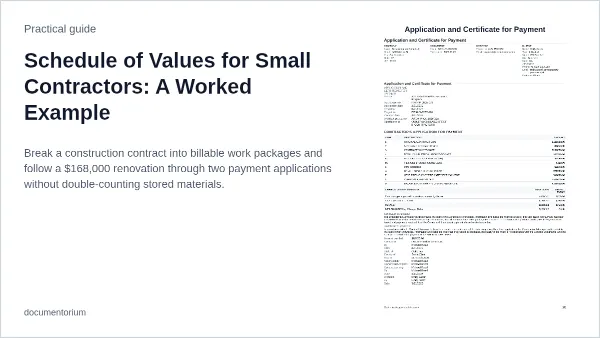
A payment application, or pay app, uses those values to show what's been earned through a cutoff date and calculate how much you're requesting this period. Documentorium's Application and Certificate for Payment template has fields for scheduled values, completed work, stored materials, and retainage. It's not an official AIA form; use the form and certification process your project requires.
Build the schedule before the first draw
Start with the scope and price in the construction contract. Use the accepted construction quote for scope detail if it forms part of that agreement. The schedule should add up to the agreed price, not your internal cost budget. Handle overhead and profit as the billing instructions require, without counting them twice. If the price is still provisional, see when to use an estimate vs. a quote.
Before the first application, confirm when the schedule is due, who approves it, and what counts as earned progress on each line. A construction schedule shows when work is planned; the SOV shows what it's worth for billing. Don't assign more value to early work just to get paid sooner. On GSA contracts that include GSAM 552.236-15(f), for example, the contractor submits the schedule for approval with enough detail for the contracting officer to evaluate payment applications.
Example: allocate a $168,000 shop renovation
This example uses a private commercial job with a G702/G703-style payment application. The amounts are illustrative, not recommended percentages or market rates. Keep line numbers consistent from draw to draw. If closeout has its own line, list the deliverables that earn payment and don't price them again elsewhere.
| Line | Work package | Scheduled value | What the reviewer can check |
|---|---|---|---|
| 01 | Mobilization, submittals, and site protection | $5,040 | Agreed setup and submittal milestones |
| 02 | Selective demolition and haul-off | $8,400 | Areas cleared and debris removed |
| 03 | Framing and blocking | $18,000 | Installed areas against the plan |
| 04 | Mechanical, electrical, and plumbing rough-in | $36,000 | Installed runs and required inspection records |
| 05 | Drywall and finish | $24,000 | Agreed installation and finishing stages by area |
| 06 | Ceilings | $28,000 | Installed grid and tile by room |
| 07 | Painting and specialties | $24,000 | Specified surfaces and installed items |
| 08 | Final fixtures and trim | $18,000 | Installed and verified components |
| 09 | Closeout documents and punch work | $6,560 | Listed handoff documents and open-item status |
| Original contract sum | $168,000 |
Keep measurements, photos, and inspection references with the construction daily report or another agreed record. Tie the evidence to the line number and billing cutoff. A photo can show that ceiling grid is installed in two rooms. To tell what share of line 06 that earns, the reviewer also needs the agreed basis, such as quantities or defined stages by room. The daily report guide shows how to record that work and identify the supporting records.
Carry stored materials forward without billing them twice
At the first cutoff, suppose $10,000 of ceiling work is complete and $6,000 of ceiling tile is in storage and eligible to bill under the contract. By the second cutoff, the crew has installed all that tile. The installation work is worth another $1,500, and no ceiling tile remains in storage.
| Ceilings (line 06) | Application 1 | Application 2 |
|---|---|---|
| Scheduled value | $28,000 | $28,000 |
| Work completed in prior periods | $0 | $10,000 |
| Work completed this period | $10,000 | $7,500 |
| Eligible materials still stored at cutoff | $6,000 | $0 |
| Completed and stored to date | $16,000 | $17,500 |
In application 2, work completed this period includes $6,000 of tile and $1,500 of installation. The same $6,000 comes out of stored materials, so only $1,500 adds to this line's cumulative total before retainage. Under AIA's G703–1992 instructions, materials that are still eligible and uninstalled stay in the stored column even after the owner pays for them. Once they're installed, move their value to work completed this period, not to work completed in prior periods.
Check what makes materials eligible and what the reviewer needs: for example, an inventory tied to the cutoff, supplier records, or proof of location, title, or insurance. A delivery ticket shows delivery, not necessarily eligibility. On federal contracts that include FAR 52.232-5(b)(2), materials delivered to the contractor off-site can be considered only if the contract specifically authorizes it and the contractor provides satisfactory evidence of title and intended use on that contract. Even for on-site deliveries, the contracting officer decides whether to allow them in the request under that clause.
Add the approved change and calculate the second draw
Between applications, the parties approve change order CO-01, adding $9,600 for a storage-room fit-out. Record it as line 10 in this example and reference the approved change. The revised contract sum is $177,600. There's no completed work or eligible stored material on line 10 yet, so nothing on that line is billable this period. Follow the project's change approval process for additions and credits, and don't put a proposed change in the approved total.
The other lines total $40,000 in completed work at the first cutoff and $52,500 at the second, with no other stored materials. In this example the contract calls for 5% retainage (the portion withheld from payment) on completed work and eligible stored materials. The first application was certified as submitted. If different rates apply to work and stored materials, moving the tile from one column to the other also changes how much is retained on its value. Check the rates, limits, and release terms for your project.
| Payment calculation | Application 1 | Application 2 |
|---|---|---|
| Contract sum to date | $168,000 | $177,600 |
| Completed and stored to date | $56,000 | $70,000 |
| Cumulative retainage | $2,800 | $3,500 |
| Earned to date less retainage | $53,200 | $66,500 |
| Less previous certificates for payment | $0 | $53,200 |
| Current amount requested | $53,200 | $13,300 |
| Balance to finish, including retainage | $114,800 | $111,100 |
The second request is $66,500 minus $53,200: $14,000 in new gross progress less $700 in additional retainage. The $111,100 balance to finish is the revised contract sum less the $66,500 earned to date after retainage. It includes the $3,500 held as retainage; it's not the amount the owner owes today.
AIA's G702–1992 instructions explain how to carry totals over from the continuation sheet and how the architect documents any difference between the amount requested and the amount certified. If the reviewer reduces your request, keep the issued certificate and reconcile the affected lines before preparing the next application. Don't use the amount you originally requested as the amount previously certified.
Before submitting, make sure the line values add up to the revised contract sum, nothing installed also appears as stored, and the amount requested matches the supporting records. If the owner also requires an invoice, reference the same application and record the charge only once.
Common questions
Do I need a schedule of values on every job?
Not necessarily. Check the contract and the owner's billing instructions. A milestone billing schedule ties payments to defined events. An SOV assigns values to work packages so you can document how much you've earned on each line. If your project uses both, agree on what triggers a draw and what determines the amount.
Can I use my estimate as the schedule of values?
Use it as a starting point, not as the billing record. An internal estimate might break out labor, materials, and overhead. The SOV should add up to the agreed contract price and group the work so the reviewer can verify each amount. For example, split a single “Drywall” line by floor if each floor will reach a billable stage in a different period and the reviewer wants progress reported that way.
Does the percentage complete show how much is installed?
Not necessarily. On a G703-style continuation sheet, divide the value of completed work and eligible stored materials by the scheduled value. At the first cutoff, the ceiling line is 57.1% completed and stored ($16,000 ÷ $28,000, rounded), but only $10,000 of work is installed. Use field records to show the quantity or area actually in place.
What if the last draw was certified but hasn't been paid yet?
Don't bill an unpaid certificate again as new work. If your form subtracts previous certificates, use the cumulative amount previously certified, not the cash you've received. In the example, that's $53,200 even if the owner hasn't paid it yet. AIA's G702 completion guidance uses the prior certificate's total earned less retainage for line 7. Track the outstanding payment separately and follow the project's payment and notice procedures.
Does approval of the schedule mean the work is accepted?
No. It establishes the price breakdown used to review billing. Keep evidence of actual progress and follow the project's separate procedures for certification, payment, and final acceptance.