Contractor Estimate vs. Quote: When to Use Each
See when to send a budget estimate or a quote, how to state the price and scope, and what to do when the work changes after acceptance.
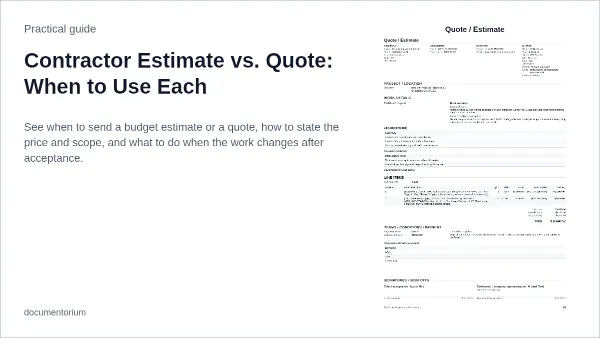
Use a preliminary estimate when the customer needs a budget before you can confirm measurements, site conditions, or material choices. Send a quote when you can define the work and offer a fixed total or a clear way to calculate the price. An estimate can become part of an agreement, and the label alone doesn't determine what's binding.
Use the quote and estimate template to show what's included, how you'll calculate the price, and when it can change.
When to use an estimate vs. a quote
| Question | Preliminary estimate | Quote for defined work |
|---|---|---|
| What price does the customer see? | An expected cost or range based on stated assumptions | A fixed total or a method for calculating the price |
| What remains open? | Measurements, site findings, selections, or other details still to verify | Stated variables such as allowances or quantities to be measured |
| What should the customer do next? | Decide whether to proceed with a site visit, selections, or a request for firm pricing | Review and, if appropriate, accept the stated scope and terms |
The Federal Trade Commission's home improvement guidance recommends getting written estimates that describe the work, materials, completion date, and price. If any of those details are still provisional, say so and explain when you can confirm them.
Show how the price is calculated
| Price basis | What to explain |
|---|---|
| Budget range | What the range covers, the assumptions behind it, and what you need to verify before offering a firm price |
| Fixed price | The total for the specified work, what's excluded, and how changes will be handled |
| Unit prices | The rate, estimated quantity and total, what counts as a billable unit, and how you'll measure and confirm final quantities |
| Time and materials | Labor rates and billing units, material costs and any markup, minimums and fees, and the records that support the bill |
A not-to-exceed amount caps charges under an agreed pricing method; it isn't automatically the amount due. State what the cap covers, when you'll alert the customer that costs are approaching it, and what approval the agreement requires before work that would exceed it.
If part of the price can change, identify it. For example, if a quote includes a $400 material allowance, name the item and say whether the allowance covers only the product or also delivery or tax. Explain how you'll apply any credit or additional charge and when the customer needs to approve it.
Use a proposal to show the base price separately from optional work. Then use the five-line quote summary to put the scope, exclusions, pricing, payment, and acceptance terms where the customer can find them.
Separate observed conditions from assumptions
Before sending a firmer offer, identify what supports it: a site visit, measurements, drawings, photographs, customer statements, or supplier information. Label what was observed, reported, or assumed. A photo-based range should not imply that concealed conditions have been inspected.
Use a scope attachment to make the boundaries readable:
- Work areas, quantities, equipment, materials, and specified finish.
- Included preparation, removal, disposal, protection, and restoration.
- Access arrangements and responsibilities for customer-supplied items.
- Permit, inspection, delivery, tax, and other charge treatment as applicable.
- Unverified conditions and the investigation or approval needed to resolve them.
- Acceptance criteria, timing assumptions, and the procedure for changes.
“Subject to site conditions” leaves the customer guessing. For flooring, identify which parts of the subfloor you could inspect and which were still concealed. If you need a paid investigation before you can price the repair, quote that phase separately. Say what the customer gets from the investigation, what it costs, and whether the fee is credited toward later work.
Say how to accept the quote and when it expires
Identify the parties, quote number, revision, and attachments. State the acceptance method and deadline, and say what accepting authorizes: a site visit, a defined phase, or the full scope. If you're sending the quote for review before signing a separate contract agreement, say so. Identify the accepted quote and attachments in any separate contract that incorporates them.
The California Contractors State License Board cautions that a document signed to authorize work could become the contract. That doesn't mean every signed quote meets the legal requirements for a contract. Under California Business and Professions Code § 7159(d), covered home improvement contracts and change orders must be in writing and signed by the parties before the work they cover begins. New York General Business Law § 771(1) also requires covered contracts and amendments to be in writing and signed by all parties.
These state examples aren't a nationwide checklist. Confirm which signatures, disclosures, and cancellation rights apply before asking the customer to accept. The FTC's Cooling-Off Rule guidance explains the notices sellers must give at the time of certain sales made at a customer's home or another covered location.
An expiration date is a deadline for accepting the offer, not a reason to reprice work already under agreement. If the offer expires unaccepted, reconfirm scope, availability, and price before reissuing it. Use estimate revision numbering to distinguish versions and the written-quote workflow to keep the accepted version, attachments, and approval together.
Flooring example: from a budget range to a fixed-price quote
Suppose a customer requests replacement flooring in one room. All amounts below are hypothetical, before applicable tax, and are not market-rate guidance.
Revision 1 — Preliminary estimate: Based on photos and the customer's measurements, the contractor estimates $3,200–$4,200 to remove and replace the flooring. The estimate is for budgeting. The price depends on a site visit and the customer's flooring choice.
Revision 2 — Fixed-price quote: After measuring the room, checking the accessible areas, and confirming the flooring selection, the contractor quotes $3,850 for 180 square feet. The price includes removal, disposal, and the specified prep and installation. It excludes repair of concealed subfloor damage. The customer accepts revision 2 through the required process.
After acceptance: two proposed changes and a cost overrun
| What happens | How to handle it |
|---|---|
| Removal exposes subfloor damage. The contractor proposes a $420 repair. | Pause the affected work, document the damage and the exclusion, and obtain the required approval before making the repair. |
| The customer asks for a different transition strip at the doorway, adding $180. | Identify the substitution and record its price and any schedule effect for approval. |
| Disposal costs more than the contractor budgeted. | Disposal was included. A higher cost alone isn't extra work. Check whether the agreed terms allow any price adjustment. |
If both scope changes are approved, the revised total is $3,850 + $420 + $180 = $4,450 before applicable tax. For each change, use a change order that identifies the accepted quote and records the agreed work, price, and schedule effect. Keep proposed or disputed items out of the approved total. On a unit-price job, an increase in measured quantities may already be covered by the agreed pricing terms; follow those terms rather than treating every increase as new work.
The Oregon Construction Contractors Board's consumer guidance recommends agreeing to use written change orders signed by both the homeowner and contractor. Its sample change order identifies the original contract, changed work, revised price, completion date, and signatures. The change-order guide explains how to carry approved changes into the work order and invoice.
If your contract calls for progress billing by work package, build the schedule of values from the final agreed scope and contract price, not a preliminary estimate or an earlier quote. The schedule allocates that price so the reviewer can check how much is billable at each cutoff.
Before you send the document
Check that a customer can answer these questions without guessing:
- Is this a budgeting range, a defined offer, or authorization for a specific phase?
- What work and charges are included, and what remains uncertain?
- Is the price fixed, unit-based, time-and-materials, capped, or a clearly identified combination?
- Which version is being offered, how is it accepted, and when does it expire?
- What must happen before additional work or charges are approved?
The quote and estimate template has fields for scope, exclusions, line items, payment terms, the change order procedure, and signatures. Use the scope or terms fields to state how you calculate the price, and identify any separate attachments by name and revision.
Common questions
Is an estimate always nonbinding?
No. An estimate can become part of an agreement. If you ask the customer to sign it, say what the signature is meant to do: acknowledge receipt, approve a specific phase, or accept the stated work and terms. The document, what the parties agreed to, and applicable law determine its effect.
Is a quote always a fixed price?
No. One quote might set a fixed total; another might charge an agreed rate for each unit installed. Ask whether the total is fixed, estimated from quantities, or capped, and check what each amount includes.
How much can a contractor go over an estimate?
Don't assume a standard percentage applies. Check the agreed pricing terms and the rules for your state and type of work. Ask for an itemized explanation: is the difference due to measured quantities at agreed rates, a change you approved, or a cost that was already included?
Should I send a revised estimate or a change order?
If no agreement is in place, send an identifiable revision and say whether it replaces the earlier proposal. If the parties already have an agreement, keep the accepted version and follow its change process and any applicable legal requirements. Sending a new PDF by itself doesn't establish approval.
How do I compare a fixed-price quote with a lower estimate?
Check that both cover the same work, materials, quantities, and charges. Ask what the contractor still needs to confirm and whether any allowances can change the total. A lower estimate that excludes disposal isn't directly comparable to a fixed price that includes it.