Catering Final Guest Count Confirmations: Meals, Minimums, and Billing
Reconcile catering guest counts, meal selections, dietary requests, rentals, agreed minimums, deadlines, and final billing before production release.
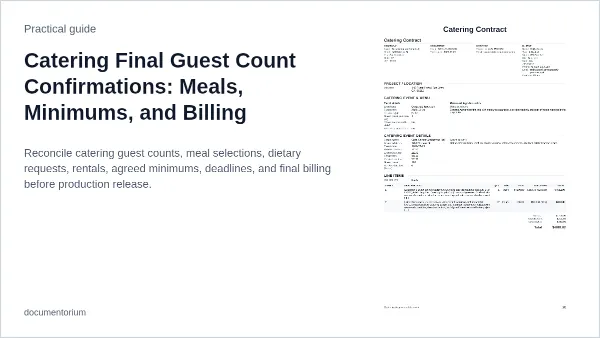
A final catering count should reconcile the people attending, meals to prepare, rental quantities, and agreed billing basis. Follow the confirmation process in the catering contract. Use a change order for agreed departures from the existing scope, pricing, or timing terms, with the approval required for the event. Keep the detailed banquet event order, seating and meal roster, and kitchen production sheets as separate, clearly referenced attachments.
For a plated holiday dinner, suppose the proposal says 120 guests, the final RSVP list says 110, and fourteen dietary requests refer to people already on that list. Those are not 124 meals. Confirm which numbers describe attendees, meal choices, and contractual billing minimums before ordering food or releasing the staff schedule. The catering proposal guide explains how to establish those terms before reaching this final confirmation.
Separate submission, acceptance, and production release
Record who submitted the count, when it was received, who checked it, the authorized client's confirmation, and the version released to the chef and service lead. A submitted RSVP spreadsheet is not automatically an accepted change to the agreement.
Use the actual contract cutoff, including its date, time, time zone, recipient, and whether it counts calendar or business days. Seven days is not a nationwide standard. For holiday events, check the actual supplier and rental deadlines as well as the customer deadline.
Reconcile the final version against the catering proposal, then use the catering estimate to price any agreed additions. Record any remaining approval or payment condition separately. An estimate does not acknowledge cleared payment, and an internal production release does not replace customer approval.
Count people once and tag dietary needs separately
| Count | What the confirmation should resolve |
|---|---|
| Attendees | Guest total, with adults and children distinguished where relevant; vendor and staff meals identified separately. |
| Meal choices | For plated service, mutually exclusive selections totaling the planned meal quantity; for buffets or stations, separately identified production quantities. |
| Dietary requests | Requirements linked to the assigned meal; several requests may belong to one person. |
| Rentals | Place settings, tables, service equipment, and any agreed reserve, with the supplier's confirmed quantities. |
| Billable guarantee | The accepted count or contractual minimum used for billing, distinguished from actual attendance and production quantities. |
For the fictional dinner, 68 beef meals, 32 fish meals, and ten special meals total 110 guest meals if those categories do not overlap. Add four separately identified vendor meals and the kitchen total is 114 meals. The fourteen dietary requests are tags on those assigned meals, not fourteen extra portions. A vegan guest with another dietary need still receives one assigned meal.
Check each request with the kitchen and record what it has accepted, what remains unresolved, and how the correct meal will reach the guest. If an accommodation is not confirmed, tell the host or authorized contact before promising it and agree on the next step. Do not label a meal “allergen-free” merely from a menu name or make an unreviewed substitution.
The FDA allergen guidance identifies nine major food allergens, including sesame; that list does not cover every possible food allergy or dietary request. Confirm ingredients, cross-contact controls, and what the kitchen can safely provide. The FDA Food Code is a model used by jurisdictions to develop their rules. Check the requirements adopted where the food is prepared and served rather than assuming the same provisions apply nationwide.
Check the labels of the actual products purchased, including replacements. FDA's label guidance explains that ingredients can change and that “may contain” statements are voluntary; their absence is not proof that cross-contact is impossible. A supplier substitution needs a fresh kitchen review of the affected dietary arrangements before service instructions are released.
Confirm commercial changes without surprise surcharges
Distinguish a food-and-beverage spending minimum from a minimum guest count. Explain the agreed billable basis if attendance falls, and how late additions are assessed for food, staffing, rentals, and safety. Record any production reserve separately, including whether its cost is included in the price. A reserve does not itself increase the customer's guarantee, and a late request does not by itself authorize a surcharge.
In the example, the original estimate of 120 does not by itself establish the final billing quantity. If the reviewed agreement permits a timely reduction to 110 guest meals and the caterer accepts it, record that basis and the four vendor meals separately. If a contractual minimum still applies, show the production quantities and the agreed billing basis without treating the minimum as an instruction to prepare extra meals.
Use the written-quote guide to preserve pricing assumptions and the change-order guide for approved revisions. A later request should state what changes, the price and timing impact, who approved it, and which earlier version it replaces. If it cannot be accepted, record the decision and tell the customer which confirmed arrangements still apply.
Make the accepted quantities easy for the customer and event team to check. For the fictional dinner, a summary could read:
Final count FC-014/R01 — contract and event identified in the packet
Guest meals: 110 (68 beef + 32 fish + 10 special)
Vendor meals: 4 additional; total kitchen production: 114 meals
Dietary requests: 14, linked to assigned meals in roster MR-014/R01
Billing basis: 110 guest meals and 4 vendor meals at agreed rates;
staffing, rentals, fixed charges, and tax per approved pricing attachment
Approval record: named customer approver and caterer, dates and times,
and the exact count, pricing, and attachment versions accepted
This is a summary, not a complete event agreement. Include the actual cutoff, event details, approved prices and total, payment terms, and kitchen-confirmed dietary arrangements in the referenced packet.
Itemize agreed charges on the invoice. Check the event's tax rules. California's Publication 115 includes mandatory tips, gratuities, and service charges in taxable gross receipts, even if paid to employees. New York's catering guidance excludes a mandatory gratuity from sales tax only if it is separately shown, identified as a gratuity, and paid entirely to employees. Do not apply one state's result nationwide or assume separately listing a charge makes it exempt.
Release one confirmed event packet
Keep one approved master packet and check that it includes:
- Event identity: customer, event date, venue, service window, contract reference, and confirmation version.
- Menu and service plan: accepted menu revision, dishes, service style, approved substitutions, and the dietary arrangements confirmed by the kitchen.
- Counts: guest meals by selection, separate vendor or staff meals, dietary arrangements, and total production quantity.
- Resources: staffing roles and hours, rental quantities, setup and breakdown arrangements, and the person checking each supplier confirmation.
- Commercial agreement: accepted billing count or spending minimum, approved additions, applicable charges, and payment status.
- Approval and distribution: authorized customer confirmation, caterer acceptance, attachment versions, and the recipients of the released packet.
Give each recipient the current information needed for their role. The kitchen and service lead need the confirmed meal-allocation and dietary instructions; the rental supplier needs quantities and logistics, and billing needs the agreed price basis and payment record. Keep guest names and personal dietary details out of copies that do not need them, using a meal or seating reference for service where practical.
Use the scope and pricing sections of the change order for accepted changes, and reference the detailed count sheet and event packet there. Keep the roster and production sheets separately; the general change-order template does not provide a dedicated meal-allocation table or kitchen production system.
Mark superseded copies clearly and tell each affected recipient when a revision is issued. A changed guest count may affect purchasing, staffing, rentals, and billing differently, so confirm those consequences individually rather than silently replacing a number in the proposal.
Sources
Sources reviewed November 14, 2026: FDA food-allergy and label guidance and Food Code overview; California CDTFA Publication 115; New York's catering sales-tax guidance; 29 CFR §531.55; and U.S. Department of Labor Fact Sheet #15, linked above. The state tax examples apply to their respective jurisdictions.
Common questions
Can the planner confirm the count?
Check delegated authority and spending limits in the agreement; a planner is not automatically authorized or automatically barred. Identify the person accepting any change to price, minimums, or service scope.
What if the client misses the final-count deadline?
Follow the agreement's stated fallback and contact the authorized approver. Record the count being used for purchasing, production, and billing, and explain any unresolved differences. If the agreement does not resolve the omission, obtain clarification before making further commitments; the original estimate is not automatically a final guarantee.
Do fewer attendees automatically reduce the bill?
No. Apply the agreed guarantee or spending minimum and the adjustment rules for meals, staffing, rentals, and fixed charges. Record any accepted reduction and its price effect. Attendance, production quantity, and billable quantity can differ.
Does marking an allergy on the count sheet confirm the meal?
No. The kitchen must confirm what it can provide, and the service team needs a reliable way to deliver that meal to the right guest. Resolve ingredient, cross-contact, and handoff questions before promising the accommodation. Tell the host or authorized contact about anything that remains unconfirmed; a dietary tag alone is not a safety assurance.
What if an ingredient or menu item changes after confirmation?
Have the kitchen reassess ingredients, cross-contact, and each affected dietary arrangement. Obtain any customer approval required by the agreement for the menu or price change, update the menu and meal references, and notify the kitchen and service lead. If an accommodation can no longer be confirmed, tell the host or authorized contact before promising the replacement; the earlier confirmation does not establish its suitability.
Does a service charge go to staff as a tip?
A compulsory service charge is not a tip under 29 CFR §531.55. Amounts distributed to employees from it must be included in the regular rate used to calculate overtime, as DOL guidance explains. State how the charge is used or distributed and whether any optional gratuity is additional. Check applicable state rules separately; the federal classification does not settle every wage or sales-tax question.
What if the count changes again?
Assess the request against the agreed cutoff and actual capacity, then confirm the decision. Record an accepted count revision under the agreement's confirmation process, using a numbered change order when the revision changes the agreed terms. Update production references, notify affected recipients, and reconcile the invoice. Do not silently replace the accepted version.