Battery Test and Registration Record: Results and Follow-Up
Record 12-volt battery test conditions, replacement specifications, and any vehicle-required battery registration, reset, or relearn procedure.
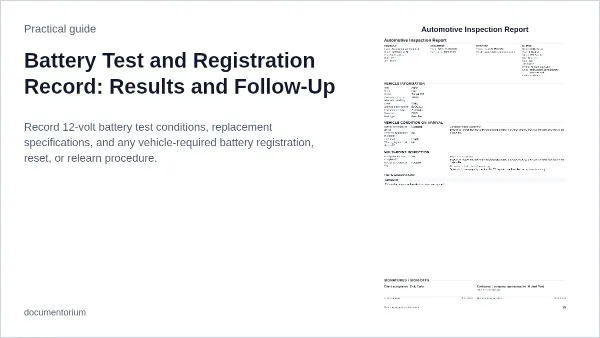
A battery test report should show what was tested, the conditions, and the recommended next step. If a battery is replaced, the record should also identify the installed specification and any vehicle-required registration, coding, reset, or relearn. Start with the automotive inspection report, using its summary and checklist notes to reference a separate battery test sheet and the original tester output.
This is a useful distinction before cold-weather travel. NHTSA's winter-driving guidance explains that battery power drops with temperature while gasoline and diesel engines need more power to start in cold weather. It recommends having a mechanic check the battery and charging system. That is a reason to investigate a slow-start complaint, not evidence that every older battery needs replacement.
Keep four decisions separate: the test finding, the proposed work, the customer's approval, and the result of the work actually performed. Here, “registration” means recording a replacement battery in the vehicle's battery-management system where required, not registering a retail warranty. The linked testing examples concern lead-acid batteries; they are not procedures for lithium-ion auxiliary batteries or high-voltage traction packs.
Record the inputs before interpreting the result
A printout saying “replace” is difficult to explain if nobody knows which rating or battery type was entered. Capture the following on the supporting test sheet:
| Record | Useful detail |
|---|---|
| Vehicle and complaint | VIN, mileage, visit date, customer-reported symptom, and recent starting or charging events |
| Battery identification | Location, manufacturer/part number, chemistry/type, labeled capacity and cranking rating, and rating standard |
| Test setup | Tester model/software, selected battery type and rating, in-vehicle or out-of-vehicle setup, and connection location |
| Conditions | Battery temperature and how it was obtained, relevant charge/rest history, terminal condition, and state of charge if reported |
| Results | Measured voltage, tester-reported cranking performance and health assessment, exact decision message, and output reference |
| Limits and next step | Tests not completed, confirmation needed, proposed diagnosis, and responsible person |
Record capacity in amp-hours (Ah) separately from cold-cranking amps (CCA). Enter the rating standard specified for the battery and test procedure; do not treat SAE CCA and EN ratings as interchangeable numbers. Label each percentage as state of charge, state of health, or another reported metric, and preserve whether it came from the tester or was calculated separately.
Keep the customer's description separate from verified findings. “Customer reports slow cranking after overnight parking” does not establish a defective battery, alternator, starter, or parasitic draw. Use the inspection report to summarize what the visit actually established.
Route the tester decision to the correct next step
| Result or observation | Record the next decision |
|---|---|
| Damaged, leaking, swollen, frozen, or otherwise unsafe battery | Condition observed, work stopped or restricted, and the applicable battery/vehicle safety procedure |
| Charge-and-retest result | Whether charging is safe and authorized, the specified procedure, and the later test reference |
| Replace result | Required connection or confirmation checks, supporting evidence, and replacement recommendation |
| Starting or charging concern | Tests completed and the separate system diagnosis still needed |
| Battery replaced | Installed specification, required post-installation steps, verification, and outstanding work |
The Midtronics GR8-1200 instruction manual, issued in January 2009, illustrates why the exact message matters. Its decisions distinguish charging/retesting from replacement and connection checks; its safety guidance prohibits charging a frozen battery, and its bad-cell warning says not to charge that battery. This is an example for that instrument, not a current procedure for every tester or battery chemistry. Follow the applicable equipment, battery, and vehicle instructions, including their safety warnings.
Save or print each result before starting another test. The GR8 manual warns that a new test overwrites the last result in memory. Retain the sequence so the customer can see what changed between tests, rather than keeping only a later favorable result. A “good battery” result is not proof that the entire starting and charging system passed.
Avoid universal voltage and health cutoffs
A resting-voltage table, cranking-performance percentage, or charging-system limit is meaningful only with its method, temperature, and product assumptions. Interstate's 2025 PowerVolt application guide separates flooded and AGM checks and includes temperature-dependent load-test criteria. Those instructions do not establish one threshold for every battery chemistry or vehicle charging strategy.
Keep state of charge (SOC)—how charged the battery is—separate from the tester's state-of-health (SOH) assessment. VARTA's guide to interpreting battery tests explains that many testers assess cold-start performance but only estimate remaining capacity and charge acceptance indirectly. Do not present a cranking-performance percentage as a measured percentage of capacity remaining or a prediction of battery life.
Record the actual value and the criterion used, including its source. If the assignment included starting or charging-system tests, preserve the operating conditions and results separately. If it did not, say so. A low reading alone does not establish why the battery became discharged.
For example, an illustrative record might read:
Customer reports intermittent slow cranking after overnight parking. Battery identity, tester settings, temperature, and initial output are retained as test A. Tester decision: charge and retest. Replacement is not yet recommended from this test alone. Safe charging and retest are proposed under estimate revision 1; the follow-up result remains pending.
That narrative gives the office a next action without presenting an unfinished diagnosis as a completed repair.
Obtain approval for the proposed work
Prepare a repair estimate identifying the proposed diagnosis or replacement, battery specification, labor, applicable fees, and any required post-installation procedure. Explain what remains uncertain. Use the repair authorization to record the accepted scope rather than treating permission to test as permission to replace.
Explain any applicable core deposit or credit for returning the old battery, including the conditions for receiving the credit. Record how the removed battery was handled and whether the credit was applied; follow the governing replaced-parts, warranty-return, and disposal rules.
California BAR's Write It Right guidance, updated January 2026, requires the customer's authorization to be recorded on the estimate before repairs begin, and explains documentation for written, oral, and electronic approvals. That is a California framework, not a national signature rule. Follow the governing requirements for the actual transaction, using the state-approval guide to distinguish the issues that need checking.
Keep the estimate revision, authorized work and amount, approver, timing, and actual approval evidence together as applicable. If a charging fault or additional diagnostic need changes the proposed scope, obtain the required further approval before added chargeable work.
Distinguish replacement, registration, and relearn
Use the battery type, dimensions, capacity, venting, and other requirements specified for the vehicle. Do not infer electronic registration requirements from an absorbed glass mat (AGM) label, the vehicle's country of origin, or the presence of start-stop alone. Coding a changed capacity/type, registering a replacement, resetting a sensor, and relearning state of charge can be different operations.
VARTA's battery-management coding guide describes self-learning, diagnostic-tool registration, and combined approaches. Its examples explain the distinction; check the exact model and current vehicle service information rather than applying a brand-wide rule.
For another example, Ford's 2025 Mustang owner's manual describes an eight-hour vehicle-sleep period for state-of-charge relearning after replacement or certain external-charging events, with the vehicle fully locked and the ignition off. That does not establish the procedure for every Ford, replace applicable service instructions, or prove a separate reset is unnecessary.
On the repair order, summarize performed work and reference a separate replacement/registration record:
| Record | What to preserve |
|---|---|
| Removed and installed batteries | Part numbers, chemistry, labeled capacity/rating, and traceability details needed for this job |
| Procedure basis | Applicable vehicle service-information reference and revision |
| Required operations | Which registration, coding, reset, or relearn steps apply, or the basis for none being required |
| Work performed | Technician, date, tool/software if used, entered specification, and actual procedure result |
| Completion and limits | Verification performed, unfinished adaptation, operating advice, and follow-up owner |
Do not mark registration complete because a tool offers a battery-reset menu. Retain the actual applicable result. If a required step cannot be completed, record the reason and the vehicle-specific restriction or next action; do not silently present the job as finished.
Hand off the evidence, not a promise of future starting
Use repair-order narrative practices to connect the complaint, test sequence, approval, and completed work. Multi-point inspection guidance helps distinguish a battery-specific visit from a whole-vehicle assessment.
Give the customer a clear summary in the inspection report, with unresolved concerns and the agreed next step. Keep replacement approval in the authorization record and completed work in the repair order. Retain tester printouts, scan-tool output, and applicable procedure references separately with matching job identifiers.
These templates provide the narrative and job record. They do not connect to a battery tester, perform electronic registration, or replace vehicle service information. A favorable test describes the result under recorded conditions; it is not a guarantee of future starting or proof that an intermittent drain has been eliminated.
Sources
Sources reviewed November 16, 2026. Instrument and vehicle examples remain specific to the linked documentation; use the applicable current instructions for the vehicle and equipment being serviced.
- NHTSA: Winter-driving tips — Cold-weather battery demands and pre-winter vehicle checks.
- Midtronics: GR8-1200 instruction manual, January 2009 — Examples of test inputs, decision messages, confirmation checks, and battery safety warnings for that instrument.
- Interstate Batteries: PowerVolt 2025 application guide — Product-specific flooded/AGM testing and temperature-dependent load-test criteria, not universal service thresholds.
- VARTA Automotive: Interpretation of battery tests — Distinguishing charge state, cold-start performance, remaining capacity, and charge acceptance when interpreting tester output.
- California Bureau of Automotive Repair: Write It Right, updated January 2026 — California estimate, authorization, work-order, replaced-parts, core-charge, and supporting-record requirements.
- VARTA Automotive: Battery-management coding for replacement — Different energy-management approaches; not a substitute for model-specific service instructions.
- Ford: 2025 Mustang owner's manual — Battery Management System Limitations — A vehicle-specific state-of-charge relearn example, not a universal reset procedure.
Common questions
Does every AGM battery need electronic registration?
No. Follow the vehicle-specific procedure. Battery chemistry alone does not determine whether registration, coding, reset, or relearn is required.
Can I skip registration if the replacement has the same specification?
Not if the vehicle's procedure requires it. A like-for-like replacement can still require registration of the new battery. Check registration separately from any coding needed for a change in battery type or capacity, and record the procedure actually completed.
Is a low-voltage reading proof the battery is defective?
No. Consider charge state, temperature, connections, and the specified test method. Unsafe batteries require the appropriate safety response, not automatic charging; do not charge a frozen battery.
Does registration repair a charging fault?
No. Record and diagnose starting, charging, or parasitic-draw concerns separately. Completing a required registration procedure does not prove those faults were corrected.
What if required registration cannot be completed at the replacement visit?
Record installation and registration as separate statuses. Preserve the failed or incomplete procedure result, the reason, any vehicle-specific restrictions, and who will complete the next step. Do not mark registration complete merely because the new battery is installed; keep the actual tool output with the job record.