Janitorial Inspection Scorecard: Example for Recurring Cleaning
Score a recurring cleaning visit, show what you could not inspect, and track each correction until it is verified.
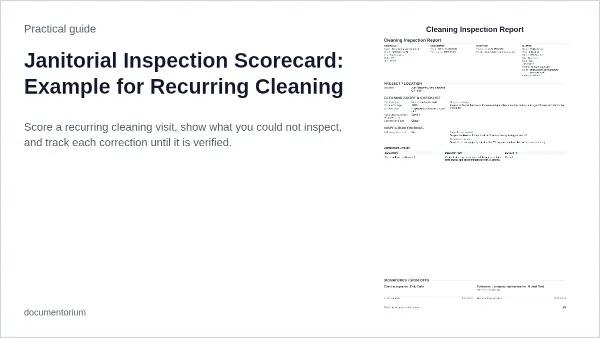
“98% passed” tells the client little if the supervisor checked only one of five floors. A useful janitorial inspection scorecard shows what was inspected, what passed, and what still needs attention.
Use the cleaning inspection report for room-by-room findings and follow-up. Keep score calculations and trends in a separate spreadsheet. For each inspection, record the site, the service visit being checked, the inspection date and time, and the inspector's name.
Turn the cleaning scope into inspection checks
List the areas, tasks, service frequencies, and proposed inspection schedule in the cleaning proposal. Confirm the scope and who will inspect the work in the cleaning agreement. The recurring cleaning contract guide explains how to assign those responsibilities.
Define each check as one observable result at a specific location. Agree on when to inspect so the results are comparable: check the lobby glass after the evening service and before morning traffic, not after a full day's use.
| Location | Expected result | What to record if it fails or can't be checked |
|---|---|---|
| East restroom, sink 2 | The dispenser delivers soap when used. | Whether the dispenser was empty or malfunctioning and whether refill stock was available. |
| Main lobby, entry mat | No visible litter or loose debris on the mat. | Where you found debris or why you couldn't check the mat. |
| Staff breakroom, sink counter | No visible crumbs or residue on the cleared counter. | What you found or why you couldn't see the surface. |
| Main lobby, interior entry glass | No visible fingerprints on the agreed glass surfaces. | Which pane had marks or couldn't be checked. |
Keep checks tied to work that was due. If the refrigerator interior is scheduled for the last Friday of the month, don't count it against an ordinary nightly visit when that task wasn't due. Use the standard vs. deep cleaning checklist to separate periodic detail work from the regular route.
A clean-looking counter isn't proof of disinfection. If disinfection is in scope, verify it separately under the site's procedure. Record what you could confirm about how the work was done, such as the product used and the contact time observed. EPA's guide to disinfectant labels explains where to find the permitted uses and the required contact time.
Calculate the pass rate and inspection coverage separately
Use one scorecard row per check. Record the location, expected result, and one status: pass, fail, not inspected, or not applicable. Use not inspected when a check applies but you couldn't verify it, such as when a room was locked. Use not applicable when the feature is absent or the task wasn't due. Record the reason for either status. If you observed that the result fell short of the agreed standard, mark it fail.
Say you use an 18-item checklist for an office inspection. The building has no elevator, so one item is marked not applicable and left out of both calculations. The breakroom is locked, so its five checks still apply but weren't inspected. Here's how the 17 applicable checks break down:
| Zone | Applicable | Passed | Failed | Not inspected |
|---|---|---|---|---|
| Restrooms | 8 | 7 | 1 | 0 |
| Lobby | 4 | 3 | 1 | 0 |
| Breakroom | 5 | 0 | 0 | 5 |
| Total | 17 | 10 | 2 | 5 |
- Pass rate: 83% (10 of 12). Divide passes by the number of inspected checks (passes plus failures).
- Inspection coverage: 71% (12 of 17). Divide inspected checks by the number of applicable checks planned for the visit.
- Follow-up: Assign the two failures (an empty soap dispenser and litter on the entry mat) for correction. Arrange access for the five outstanding breakroom checks. The breakroom has 0% coverage and no pass rate yet.
If checks applied but you couldn't complete any of them, report 0% coverage and leave the pass rate unscored. If none of the planned checks applied, mark both measures not applicable.
Record both percentages, their counts, and the missed checks in the inspection report. If the plan calls for sampling one floor, completing every applicable check there gives you 100% coverage of that sample, not of the building. If you planned to inspect five floors but reached only one, log the applicable checks you missed on the other four as not inspected. Agree in advance on the sampling plan, required areas, minimum coverage, and passing threshold.
Assign corrections and verify the result
Don't wait to finish scoring before flagging an immediate hazard, such as pooled water in a walkway. Follow the site's safety procedure and notify the responsible contact promptly. Agree with the client on which findings need prompt action and which can wait until the next visit.
- Log the finding. Give it an ID and record the location, failed check, time, and what you observed. For example: “R-07, east restroom, sink 2: soap dispenser empty at 6:40 a.m.” Use the photo documentation checklist when an image would help and site rules allow it. Avoid including occupants or confidential materials.
- Assign the correction. Put the finding ID, responsible person, and deadline on the cleaning work order. For R-07, the crew lead will refill the dispenser before 8 a.m. If there's no refill stock, record who was notified and leave the finding open.
- Recheck and report. Record the result (“Dispenser delivers soap”), date, time (7:50 a.m.), and verifier's name against R-07. Tell the client which findings were corrected and which remain open. A crew note states what was done; the recheck shows whether it fixed the problem.
When the same defect recurs, look at the task, time available, access, and supply arrangements. The University of Virginia's custodial quality program scores individual items and has supervisors investigate and plan corrections when a room's score exceeds the program's threshold. The 2025 ISSA Cleaning Industry Management Standard, section 1.2.3, covers measuring performance against the scope, responding to inspection results, and tracking improvements. Neither sets the passing score for your account.
Common questions
How often should I inspect a recurring cleaning account?
Set the frequency based on the scope, traffic, and history of complaints or failed checks. Rotate the areas you sample so you don't keep inspecting the same easy-to-reach spaces. Schedule additional checks for recurring problems and report those separately from the regular sample.
What is a good passing score for commercial cleaning?
There isn't one threshold for every site. Agree on a pass rate and minimum coverage with the client. Decide which issues require prompt action regardless of the score and which areas must be inspected before you can call the inspection complete.
What if the client supplies the soap and runs out?
An empty dispenser fails a check for soap availability. Record the shortage and notify the person responsible for restocking. If the agreement excludes documented client stockouts from the contractor's performance score, report that adjusted score separately and keep the original finding and pass rate.
Do I change the inspection score after a failed item is fixed?
No. Keep the original result and log the correction and verification against the finding ID. If you score the reinspection, report it separately with its own date, planned checks, and coverage.
How do I report a monthly pass rate?
For comparable scheduled visits, add the passed checks across visits and divide by the total inspected. Don't average the percentages if the visits had different numbers of checks. Show coverage across those same visits, and keep complaint follow-ups and reinspections separate so they don't change the scheduled inspection results.